

Reform Options for County Clerk Elections
Summary
Half of all states select their chief local election officials (often the county clerk or county auditor) through partisan elections. Because of how they are chosen, these officials, who should oversee elections neutrally, often have close ties to a competing party, or at least the appearance of such ties. With polarization increasing, this selection method can undermine voter trust and open the door to hyper-partisans unwilling to treat contestants equally.
This brief evaluates these problems and proposes that states transition from partisan to nonpartisan election as a practical and easily implemented solution. Options for transitioning to nonpartisan elections are discussed and potential constitutional and policy concerns considered.
Background
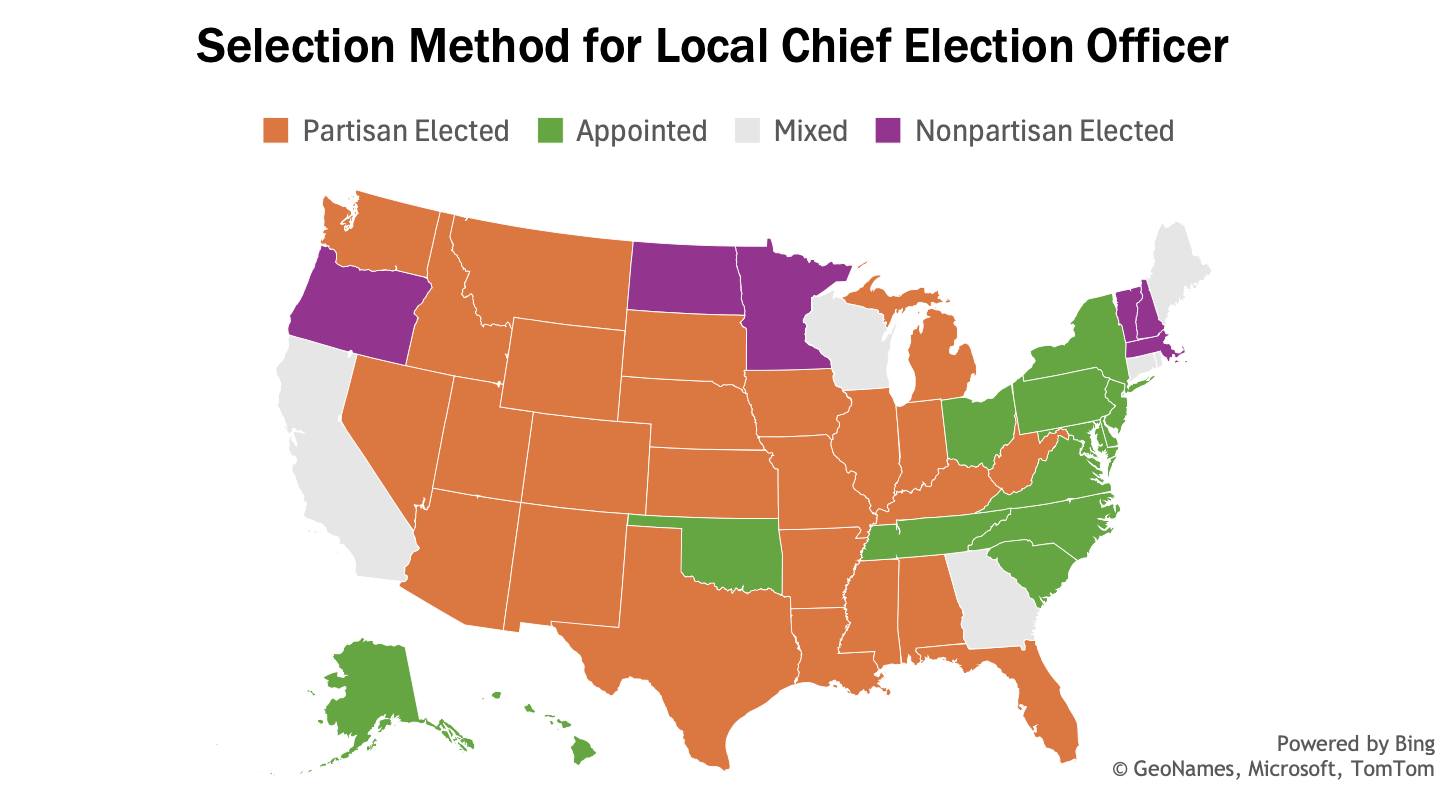
Across the United States, 31 states require the chief local election official to be elected. Twenty-five of these states use partisan elections (with party labels on the ballot), while 6 states employ nonpartisan elections (no party labels). In 13 states, appointment is the primary selection method for LEOs, while in the remaining 6, there is substantial variation between jurisdictions.
The map below provides this information on a state-by-state basis. (Many states have some degree of variation; states are categorized by their predominant selection method.)
Problems with Partisan Elections
In an era of increasing polarization, partisan elections can create challenges for local election officials, and for democracy more broadly. Fair election administration requires visible impartiality, which is undermined when LEOs must run partisan campaigns to obtain and hold office. As elected officials of one party, LEOs often have public roles with their local party that can appear in conflict with their election responsibilities. Individuals may be drawn to the office out of strongly held views about which party is right or wrong in its views on elections. Some LEOs may aspire to a further political career, creating the need to curry favor with party leaders and primary voters.
All of these factors can undermine trust, neutrality, and fairness.
Public opinion data suggest voters have concerns about partisan election of election officials. The biannual Survey on the Performance of American Elections fielded by the MIT Election Data and Science Lab has consistently found that large bipartisan majorities support “only selecting election officials in a nonpartisan manner.” In 2024, for example, 79% of Democrats, 79% of Independents, and 70% of Republicans supported that proposal.
Similarly, Election Reformers Network (ERN) found in a 2022 survey that 82% of voters felt it is very important that “local and state election officials act in an impartial manner.” In the same survey, 68% agreed that “it is difficult to trust the impartiality of election officials who are elected with the support of a political party.” The 2020 Cooperative Election Study also found that a plurality of voters (46%) preferred selecting local election officials through nonpartisan elections over partisan elections (24%) or appointment (11%).
Partisan elections also create problems for LEOs themselves because of expectations that arise from the parties. Recently published research by Election Reformers Network found that partisan-elected LEOs often experience significant pressure from their party. While few reported being asked to actually break election laws, many experienced pressures to validate partisan narratives or take other actions to publicly support their party.
These experiences have reshaped how some LEOs view partisan elections for election officials. The ERN research mentioned above found broad support among LEOs for reforms that could better separate their work from the partisan fray, including ending partisan elections. In some states, associations of election officials have advocated for legislation to end partisan elections. Another indication of LEO sentiment is the growing number of officials running as independents.
Appointment or Nonpartisan Election?
Two options are available for states that are considering changing from partisan election of LEOs. LEOs can be appointed or they can be elected in nonpartisan elections.
Arguably, the appointment approach is optimal. Researchers have found robust evidence that appointed LEOs out-perform elected LEOs on key metrics. Additionally, anecdotal evidence from the ERN report suggests that appointed LEOs receive less pressure from political parties and express stronger support for maintaining a clearly impartial posture in their communities.
Despite these considerations, many states that are looking to transition from partisan elections will likely opt for nonpartisan elections rather than appointment models. Electing county officials is familiar to and often preferred by voters, as the CES survey referenced above indicates. More recently, a 2024 survey commissioned by the Sutherland Institute, a Utah-based nonpartisan policy think tank, found that 74% of Utah voters said the state’s chief election official “should be elected by voters,” not “appointed by elected officials.” Another consideration is that some states may lack an obvious option for who would appoint the LEOs, entailing the need to establish new entities such as local election boards.
For these reasons, nonpartisan election is likely to be a more practical option for many states, and this briefing will focus primarily on that option.
Nonpartisan elections are used for numerous county and municipal elections around the country. Relevant examples of states that use nonpartisan elections at the county level include North Dakota, for all county offices including auditor (the LEO), and Utah, for school boards. (See ND Code §16.1-11-24, and UT Code §20A-6-203.)
Both states use a two-round process for these nonpartisan elections. At the time of the party primaries in both states, a nonpartisan ballot listing all candidates for all nonpartisan offices is provided to all voters, both those voting in the party primary and those voting only on the nonpartisan offices. The two candidates with the most votes in this primary election advance to the general election. This structure prevents the election of a candidate who has only the backing of a small minority but who prevails due to vote-splitting in a crowded, one-round election process.
Statewide or County Option?
Typically, partisan elections are established in statute, not the state constitution, meaning nonpartisan elections could be enacted by the state legislature through the ordinary legislative process. This legislation could take two forms: (1)require nonpartisan LEO elections statewide, or (2) establish a county-level option for nonpartisan LEO elections.
Legislation could require all counties to hold nonpartisan elections for the local chief election official, while leaving unchanged other county elections. Many states already permit nonpartisan elections for local offices, meaning an existing framework in law exists that could readily apply to LEO elections.
Alternatively, legislation could establish an option for counties to shift to nonpartisan clerk elections at the discretion of the county legislative body. Providing local options for electoral changes has recent precedent in numerous states. For example, in 2012, the Utah state legislature passed HB 172 which gave counties the option to administer elections entirely by mail.
Some states already have a structure in place for local decision-making about how LEOs should be selected. In Montana, county commissions are permitted to transfer election responsibilities from the partisan-elected county clerk to a new, appointed election administrator (MT Code §13-1-301). Nine of Montana’s 56 counties have taken this path. In Washington, the seven counties with home rule charters have changed from partisan to nonpartisan elections for county auditors (who oversee elections). Minnesota allows the county commission and clerk to decide whether the clerk will be elected in nonpartisan elections or appointed (MN Code §375A-1205 and §375A-10).
Assessing Criticisms of Nonpartisan Elections
Nonpartisan elections are not without their critics, who sometimes raise two potential risks. First, some suggest that voters will not have enough information about the candidates to make an informed choice. Second, some raise concerns that removing parties’ ability to influence nominations via partisan primaries will create a risk of rogue candidates getting elected. Closer analysis reveals that each concern is more likely to materialize under the current partisan election system than under the alternative of nonpartisan election.
CLAIM 1: WITHOUT PARTY LABELS, VOTERS WILL BE MISINFORMED
Voters often use party labels to guide their choices when casting a ballot, leading critics to argue that nonpartisan elections deprive voters of vital information for making an informed choice. This claim is typically leveled against the use of nonpartisan elections to elect officials on local legislative bodies or school boards, where it is argued that knowing candidates’ ideological positioning is important for voters.
Election administration, however, is not an area where officials’ political ideology can or should impact their performance in office. Election policy is mostly established by state law, and LEOs are required to implement the law, with little discretion to impose their own policy preferences. This is appropriate: for elections to be fair, procedures must be implemented uniformly across the state.
It is misleading to voters, and detrimental to elections, for LEO candidates to campaign on promises to implement one side’s election policies. Far better for LEOs to campaign based on their relevant skills and experience. Nonpartisan elections can better allow for such considerations to be the primary focus for voters.
CLAIM 2: WITHOUT PARTY NOMINATIONS, ROGUE CANDIDATES WILLPREVAIL
Partisan elections allow political parties greater influence over which candidates are nominated. Traditionally, this gatekeeping power was understood as a responsibility to put forward only qualified candidates, leading to the fear that nonpartisan elections—in which parties have no vetting role—may lead to the election of unqualified candidates. Yet examining the record points in the opposite direction, with the current partisan election system leading to a higher risk of the election of rogue officials.
Under partisan elections, it is increasingly easy for highly partisan, activist candidates to gain traction in low turnout party primaries and capture the party’s nomination, even against more experienced and qualified candidates. Since so many general elections are uncompetitive between the parties, this essentially ensures the election of rogue candidates in some cases.
Nonpartisan elections change this dynamic by removing candidates’ need to appeal to the party base and allowing the broader and more representative general electorate to choose among multiple competitive candidates. Nonpartisan elections would likely advance more qualified candidates than partisan elections, because the lack of party labels and partisan campaigning would make it more likely for candidates to campaign based on the knowledge, skills, and experiences they would bring to the job.
Additionally, candidacy requirements could be established to ensure that only experienced and prepared professionals compete for this office. Just as judges, district attorneys, and attorneys general must have law degrees, state law could establish a training or experience requirement for clerk candidates. Such a requirement could specify a certain number of years working in election administration, or a specific certification in election administration, as necessary to qualify for the ballot.
Assessing Potential Constitutional Concerns about Local Options
Itis clearly within a state legislature’s authority to require nonpartisan election of LEOs across the state, especially given that most state constitutions explicitly provide for election procedures to be established by law. However, creating a local option for jurisdictions to opt into nonpartisan election may come up against at least two constitutional challenges. One challenge rests on the assertion that creating a local option improperly delegates the legislature’s authority to local governing bodies, while another claims that allowing variation across a state violates uniformity requirements. Both challenges are undermined by legal precedents, suggesting legislation giving counties a local option for nonpartisan LEO elections would likely be constitutional in most states.
CONSTITUTIONAL CHALLENGE 1: IMPROPER DELEGATION
Historically, opponents have argued that local option laws improperly delegate legislative responsibilities to the people of a locality, based on the principle that there are certain inherently legislative functions that legislatures must retain for themselves. However, courts have consistently rejected this argument in longstanding precedents. In State v. Briggs, the Utah Supreme Court considered a law that allowed the voters of each city and county to vote on whether liquor could be sold locally. In its decision upholding the law, the Court emphasized that courts around the country had rejected arguments that local option laws improperly delegate legislative power to voters. The Court further noted that the law in question could not be considered delegation at all, because all it left to voters was deciding between two options that were thoroughly defined in statute (as would be the case when choosing between partisan and nonpartisan election). While opponents could argue that a local option law for nonpartisan LEO elections improperly delegates the legislature’s responsibility to regulate the “manner” of local elections, it has been well-established that this argument does not hold up in court.
CONSTITUTIONAL CHALLENGE 2: NON-UNIFORMITY
Local option laws have also been challenged on the grounds that they fail to treat localities uniformly, in violation of constitutional uniformity restrictions. Opponents could use such restrictions to argue that by defining a nonpartisan election process that some counties opt into, but others do not, the legislation would not apply to all counties uniformly. This challenge would also be unlikely to succeed. In the aforementioned case, State v. Briggs, the Utah Supreme Court rejected similar arguments and held that the local option law did not violate the state constitution’s uniformity clause. Other state supreme courts considering how local option laws comport with uniformity provisions have ruled similarly.
Note that the local option caselaw considers situations where the legislature allows the voters of a locality to decide between the statutory options, rather than allowing the county legislative body to make such a decision. But there is nothing in state constitutional caselaw to suggest this situation would be handled differently.
Conclusion
Partisan election of election officials happens in no other democracy in the world, and it’s easy to understand why. At a time of increasing polarization and election disinformation, requiring our election officials to officially play as members of a “team” while simultaneously serving as the “referee” creates unnecessary and avoidable conflicts of interest. Among various alternatives adopted by states and jurisdictions around the country, nonpartisan election is perhaps the most viable and impactful—as it would be straightforward to enact, easy to defend against constitutional challenges, and would make a real difference in establishing clear standards of nonpartisanship and neutrality in election administration.