
Policy Brief: Key Election Oversight Bodies across the States
Across the United States, a range of officials and entities carry out critical election oversight at the state and local levels. Despite substantial variation in their structure and responsibilities, one feature is consistent: political parties play a central role.
This brief examines the principal institutional arrangements that shape election oversight across the states.
State Chief Election Officers
Chief election officers (the secretary of state in most states) oversee elections and set some election regulations. No state has a nonpartisan process for electing or appointing its chief election officer: 33 are elected in partisan elections, while the remainder are appointed by governors, legislatures, or state boards that are comprised of party nominees.
A 2020 analysis by Election Reformers Network found that significant percentages of chief election officers had taken partisan actions while in office, such as publicly endorsing candidates, taking positions on ballot measures, or chairing presidential election campaigns. For example, approximately 20% of elected chief election officers lost lawsuits arising from circumstances where their official actions appeared to favor their political party. These partisan actions occurred at a higher rate among elected secretaries of state, and particularly among secretaries who were simultaneously running for higher office.
Partisan actions taken by secretaries of state likely create perception problems for other election officials, including chief local election officials (LEOs), such as county clerks, recorders, and auditors. This dynamic may be most acute in years when many sectaries are on the ballot, as is the case in 2026, with 25 secretaries running for election, including 10 running for higher office.
State and Local Election Boards
Boards vary in their geographical jurisdiction (state or local) and the extent of their involvement in elections. Several states give a central role to election boards, others have boards solely for the specific function of canvassing and certifying results.
Overall, 17 states have a state-level electon board with significant authority. In 10 of these states, the board is the primary election authority, while in 7 states the board shares authority with a secretary of state.
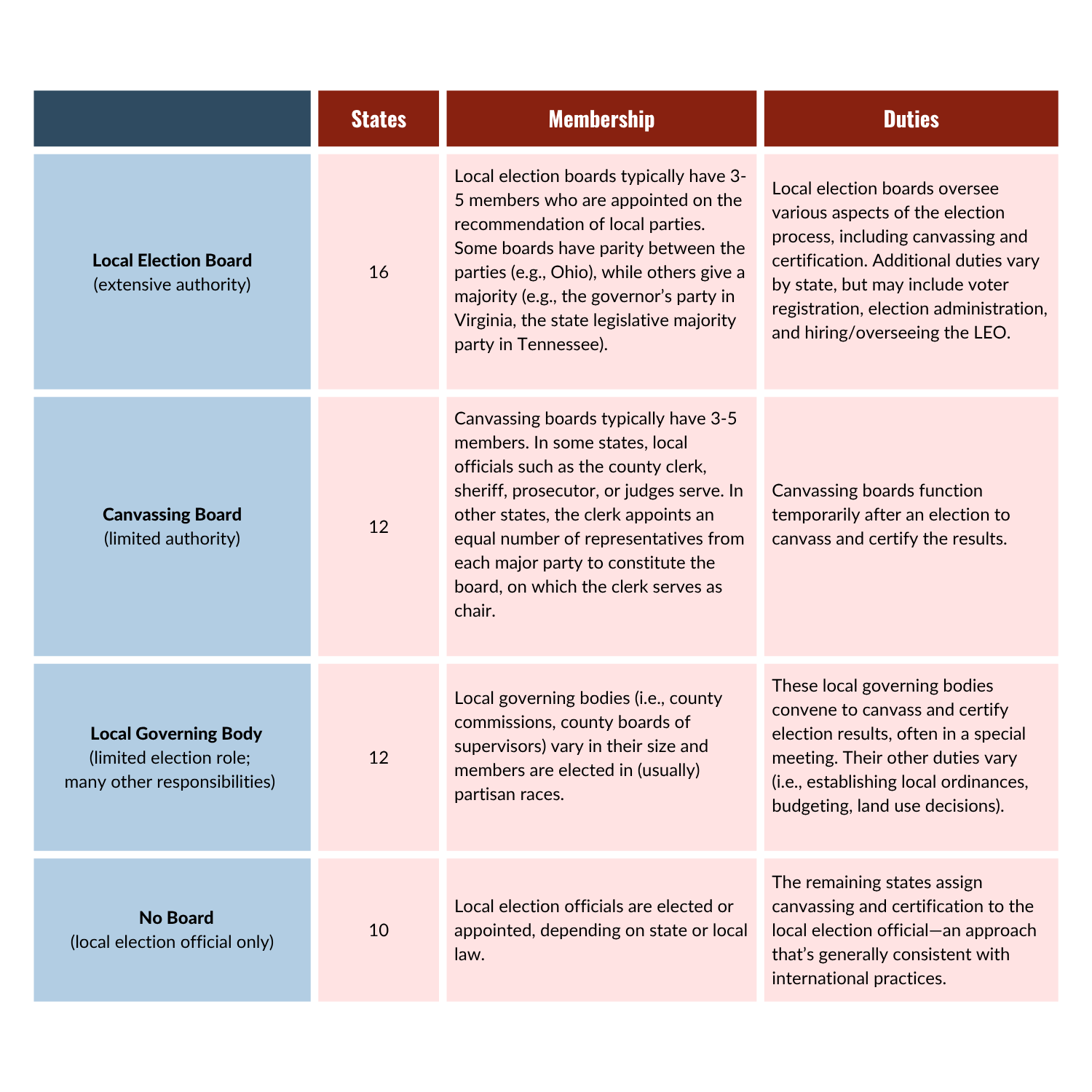
Many states also have local election boards that vary widely in their structure and authority. The following table describes several types of boards.
Local Election Boards with Administrative Functions
Sixteen states maintain dedicated local election boards that oversee most aspects of election administration. Often these boards are responsible for appointing or removing local election officials.
In most states, members of local election boards are appointed from lists of nominees provided by the local political parties. In one state, Mississippi, members of local election boards are elected in partisan elections.
In nine states, boards are structured with an odd number of members, ensuring that one political party holds a majority, while seven have an even number for partisan parity. In some cases, board control is determined by which party won recent statewide elections for the governorship or state legislature.
Despite these differences in the size and selection method of local election boards, in each state these structures embed partisan representation within the administration and oversight of elections. Furthermore, only individuals with ties to local party politics are likely to be nominated for a seat on the board — preventing independent and nonpartisan candidates, while simultaneously creating strong links between those charged with neutrally overseeing elections (boards) and those competing in them (parties). These institutional features are a critical channel through which partisan pressure creates ethical challenges and conflicts of interest in election administration.
Boards and Commissions that Primarily Certify Results
In 12 states, canvassing boards are constituted primarily to canvass and certify election results; these boards may include local elected officials (e.g., county clerk, sheriff, prosecutor) and representatives of the major parties. An additional 12 states empower local governing bodies — such as county commissions or boards of supervisors — to canvass and certify elections; the members of these boards are also typically elected in partisan contests. (The remaining 10 states entrust certification to the LEO.)
Most of these certifying boards do their jobs without controversy. However, refusal to certify by county officials is on the rise following misinformation associated with the 2020 presidential election. A national ethics watchdog determined there were more than 30 occurrences in 2020 and 2022, across eight states, in which public officials attempted to disrupt certification of election result. By law, certification is a ministerial responsibility, meaning courts can, and have, compelled refusers to comply with the law and certify.
NM’s Otero County Lawsuit
In June 2022, the county commission in Otero County, New Mexico, refused to certify primary election results based on unfounded concerns about voting machine security.
Following a state supreme court order, a majority of commissioners changed their votes and certified the results. Commissioner Couy Griffin commented:
“My vote to remain a ‘no’ isn’t based on any evidence. It’s not based on any facts … It’s only based on my gut feeling and my own intuition."