
Building Elections that People Can Trust
In 2012, while working for the International Foundation for Electoral Systems (IFES), I led a group of international election administrators on a tour of polling stations across Maryland, D.C., and Virginia. Many were professionals from countries with histories of volatile democratic transitions and hard-won reforms. What they found most striking about our elections was America’s unique trust-based system, which depended on the good faith of both election officials and voters. While American elections also include various detailed safeguards, the visitors commented on how this system would never work in their nations where such trust often did not exist.
Back then, I remember feeling proud of being part of a system that worked. But today, that pride has been replaced by a different sobering reality: you cannot run a “trust-based” system once the trust has evaporated.
While the United States has always existed in a political duopoly — a system where two major parties set the rules, draw the lines, and run the machinery — the foundations of our previous good faith have crumbled, and our election processes face a crisis of legitimacy. A 2024 Gallup poll found that national confidence in election integrity has fractured along partisan lines, sitting at a mere 57% overall, with trust among Republicans plummeting to a record low of 28%. Since then, the landscape has only grown more volatile. With rapid developments — ranging from federal investigations into ballot handling to high-profile proposals for nationalizing election oversight — public friction over election integrity is reaching a fever pitch.
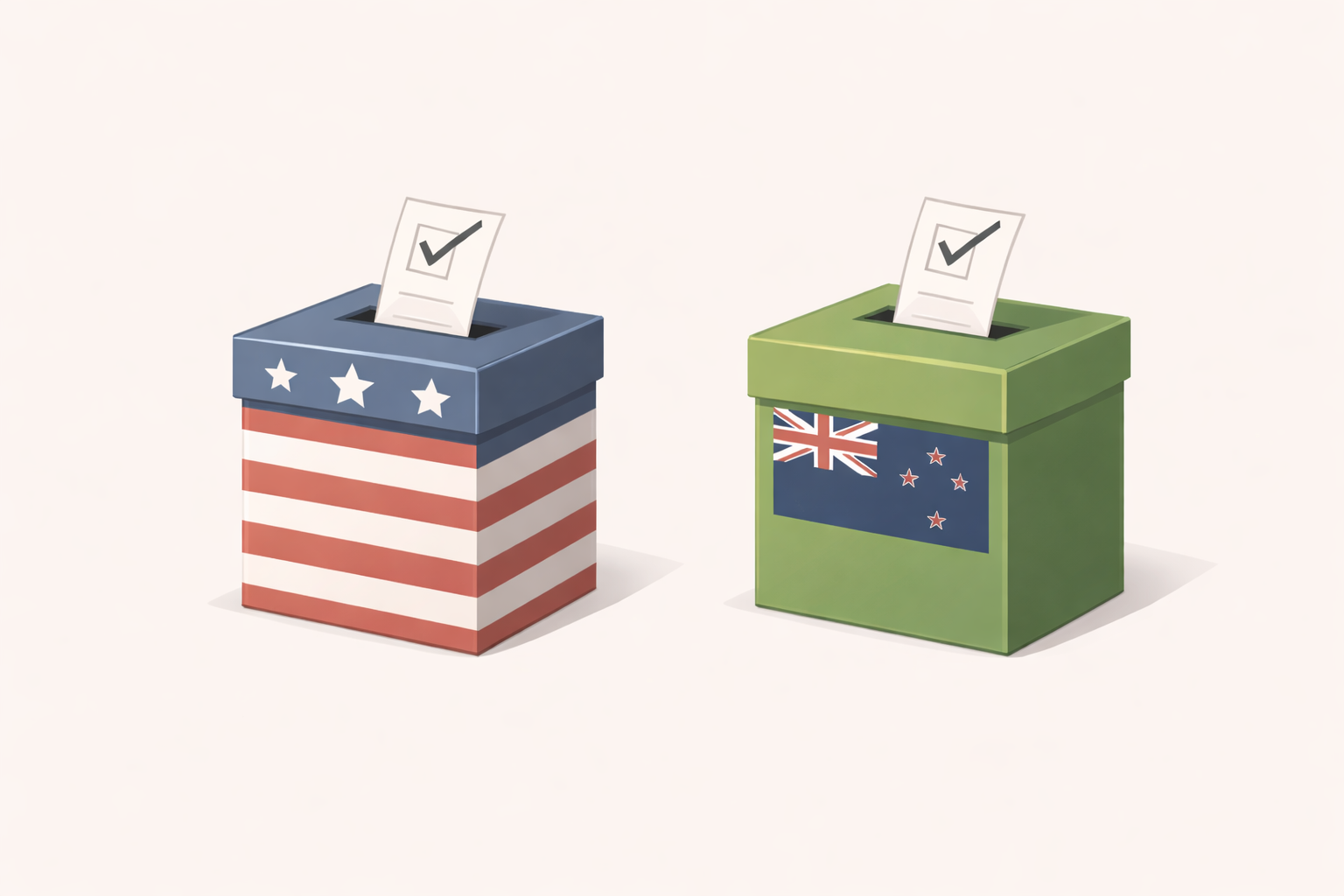
While breaking our increasingly polarized, two-party system remains a daunting structural challenge, a look at another democratic nation’s recent political and electoral history might offer some revelations. For decades, New Zealanders lived in a system that looked remarkably like the current American one — a duopoly where the challenge wasn’t a sudden collapse, but a slow-motion crisis of legitimacy. But instead of letting the system collapse, a voter-led movement pushed to move the responsibility for setting rules and managing the mechanics of elections away from political parties and into the hands of a professionalized, independent authority. Today, New Zealand’s citizens boast some of the highest levels of trust seen in an electoral process anywhere in the world.
New Zealand’s story proves that trust isn’t a happy accident of culture; it can be built by design through intentional structural safeguards.
Turning Crisis into Opportunity for Reform
In the late 1970s and early 1980s, New Zealand was a pure two-party system. It utilized the same first-past-the-post (“winner take all”) election system used for most races in the United States. In two consecutive elections (1978 and 1981), the Labour Party won the most popular votes nationwide, but the National Party won the most seats and stayed in power.
The public didn’t just see this as a quirk of geography; they saw it as a systemic failure.
The “duopoly” was perceived as manipulating the rules to stay in power, including through gerrymandering and entry requirements for third parties to compete. Under immense public pressure, the government appointed a Royal Commission on the Electoral System, which excluded all sitting politicians. This nonpartisan commission, comprised of judges and academics, recommended a comprehensive set of structural reforms to make the system more accountable. While it took several more years of public pressure, by the early 1990s the country codified a new system of structural guardrails designed to ensure the rules of the game remained fair, stable, and independent of political interference.
Lessons for the U.S.
New Zealand’s success builds on structural safeguards that make partisan manipulation more difficult. Here are four pillars of the New Zealand model that offer vital lessons for the U.S. context.
Statutory Independence
In the U.S., we often rely on the individual integrity of election staff to act as a neutral buffer against political winds. This creates a systemic fragility: when the “referee” is also a member of a political team, even the most honest technical decisions can trigger a crisis of public perception. In New Zealand, the law assumes that institutional independence is essential for guaranteeing trust. The country’s Electoral Commission is formally separate from other government departments, and its members are selected in a way that guarantees support from all major political parties.
Mixed-Model Boards
While the Electoral Commission provides the legal shield, New Zealand realizes that independence doesn’t have to mean “no politicians” in every case. For high-stakes decisions like redistricting, they use a mixed-model Representation Commission that balances partisan interests rather than ignoring them. They seat political rivals (representatives from the governing and opposition parties) at the same table as neutral professionals like the State Auditor and Chief Statistician. The partisans keep each other honest, while the neutral professionals hold the tie-breaking power.
Behavioral Standards
In New Zealand, neutrality isn’t just recommended — it’s required. Officials working within the Electoral Commission must sign a Code of Conduct which mandates they maintain a “buffer” between their job and their private beliefs. They are legally required to carefully manage their political activities, avoid public comment on political matters (even in a personal capacity), and resign if they run for office. This creates a system of verifiable neutrality. The public doesn’t have to guess if an official is biased; they can see that the official is legally barred from displaying bias, with clear consequences for violations.
Supermajority Safeguards
A primary driver of polarization in U.S. elections is the ease with which a slim partisan majority in a state legislature can alter the rules of the game. To insulate the electoral system from just such political interference, New Zealand instituted procedural hurdles to making significant changes to the rules. Changing core features of the system, such as voting age or the method for drawing district boundaries, requires either a 75% supermajority in parliament or a public referendum. This ensures that election rules don’t flip-flop every time a different party takes control and only change when there is broad, cross-party consensus that citizens can trust.
In 2012, I felt proud of an American system that ran on trust and faith. Today, as that system is increasingly tested, New Zealand’s model — which moved the country from one where politics were just as polarized as ours to one where the election process instills deep public trust — offers a roadmap for insulating election management from partisan influence and anchoring it in a professional, neutral authority that works for the people. New Zealand proved that protecting the machinery of democracy doesn’t require everyone to suddenly get along; rather, it requires a commitment to a fair set of rules even when they don’t.
We may not be able to simply wish our way back to the good faith of the past, but we can choose to build a system that is designed to earn Americans’ trust once again.